
Best plugins for techno music production

Analog synthesizers have been essential for techno music production since the beginning of the genre, but lately, things have changed and producers are making hits from their bedrooms. Producers aim for warmth in their sounds which is one of the characteristic elements of analog gear. With all of the new plugins on the market that can replace analog gear, we have shortlisted and prepared a list of the best plugins for techno music production.
Best Plugins for Techno Music Production
1. u-he Diva
Diva is one of the most popular soft synth plugins for techno music producers. The oscillators and filters are based on classic analog synth hardware. This plugin is very versatile with its mix and match panels for custom layouts, helping you create raw and experimental sounds.
Control voice detuning per oscillator, adjust variance between individual voices, and more to create an imperfect analog-like sound.
download
| Best VST Plugins of 2022 – Click here to checkout
2. Arturia Pigments 2
Arturia Pigments 2 is a complex tool for creating new and interesting sounds. It has Vintage FM and granular synthesis that lets you upload your sounds and warp them.
Modulate extensively with 3 envelopes and LFOs. The fact that you can combine virtual analog and wavetable oscillators with a sample engine, gives immense possibilities for creating that new unheard techno sound.
download
| Best House & Techno Sample Packs – Click here to checkout
3. Wide Blue Sound Elysium
Elysium is a synthesizer with its focus on organic and beautiful sounds. The soundbank has acoustic instruments and analog classic sounds. Choose sounds by their pitch range or mood. Modulate with one click several parameters. Even the most simple patch can move and breathe using the macro knobs to create techno atmospheres.
download
4. iZotope Trash 2
Distortion has become an essential tool for techno. Izotope Trash is the most flexible distortion plugin out there. It has Multiband mode with four frequency bands, each of them can be processed with a different type of distortion. It’s the perfect tool for processing techno rumble basses and the filters are powerful and clean for resonant sounds.
download
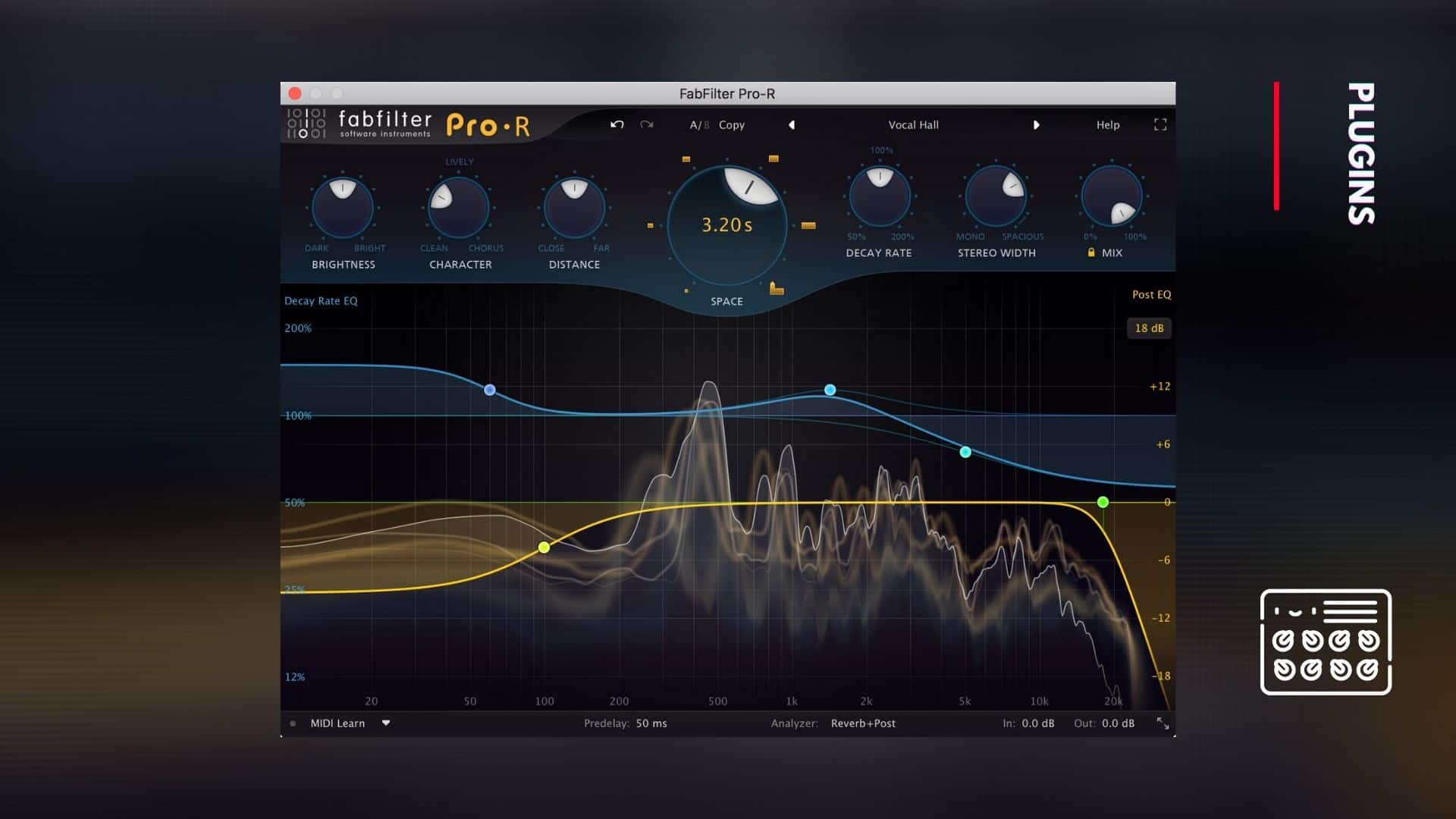
5. Fabfilter Pro R
When creating reverb-distorted rumble basses, Fabfilter Pro R is on top of the game with its user-friendly interface and realistic room modes. This reverb is great when creating ambiance for heavy techno tracks, but can also be lush and beautiful. Be it percussion or heavy synths as commonly seen in techno music, if you want the sounds to have a bit more space fabfilter pro r is definitely one of the best plugins for the purpose.
Overall, it’s a great reverb that sounds realistic and fits great in the mix.
download
6. Soundtoys Decapitator
This plugin brings the best of analog distortion to your digital studio. It has five analog saturation models that you can use to warm up, give some edge, or bring forward into the mix sounds. Great saturation algorithm to create signature techno sounds.
download
7. Arturia Prophet V
The Prophet V is the best emulation of the classic Prophet synthesizer, the audio quality is unmatched with any other plugin. It has 3 different emulations, the VS / 5 or hybrid (mix between them). The VS is one of the first synthesizers to work with four oscillator wavetables and the V is a subtractive synthesizer with 2 oscillators. It has amazing presets and has been one of our favorite plugins for creating lush pads and vintage lead sounds that stand out in the mix. It is one of the easiest and most intuitive synthesizers and one of the best for techno music production.
download
8. Abbey Road TG Mastering Chain
Abbey Road TG Mastering Chain is a great tool for mixing and mastering, it is an emulation of the actual chain used in Abbey Road since the ’70s and up until now. The compressor is harsh, but in a way that recreates the original TG and serves well for techno music. All five modules can be used independently. This chain is one that has some character and is not the one if you are looking for transparency, but it will give you that extra grit that is perfect for techno music.
download
9. u-He Satin Tape
If you are looking for some tape saturation, look no further than this plugin. Arguably the best tape emulation out there. Use up to eight instances of Satin at once using the group panel. This plugin will give texture to any atmospheric sound, give it grip and make it perfect for raw techno sounds. Using a bit of each attribute of the Tape section will give you a “glued” retro vibe.
download
10. Soundtoys Echo Boy
The Echo Boy is a delay plugin with Single Echo mode, Dual Echo, or Ping-Pong for great stereo echo effects. A great feature of the Rhythm mode is when you fine-tune the Groove, Feel, and Accent controls, you can create echoes that push or pull against the beat and give weight to the sounds. Also, you can shuffle or swing to match the groove of your song, it gives you control that no other delay plugin does.
download
Read Next: The best plugins to overcome writer’s block as a musician
Image credits: Fabfilter

Latest magazine
March 28, 2024

Magazine
- Arodes cover Interview
- Armin van Buuren: Breathing In [Exclusive Interview]
- Ibiza 2024: What To Expect
- Burak Yeter: A Day In Space [Exclusive]